
Hotel Management System in Nepal: Complete Guide
Automate Your Hotel Operations & Boost Direct Bookings
Manage rooms, reservations, guest check-ins, GST billing, and reports effortlessly with our modern cloud-based software.
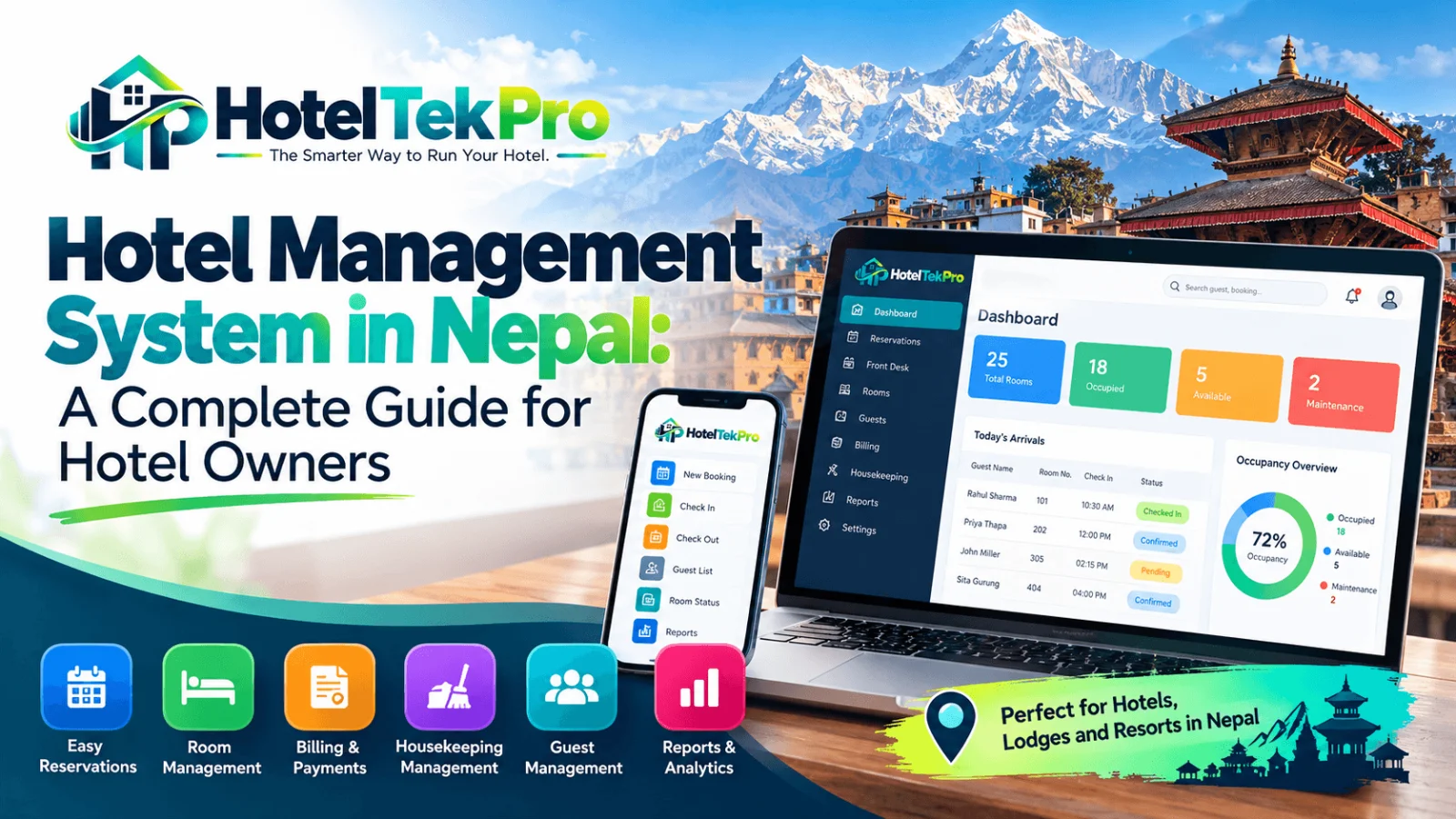
Running a hotel in Nepal is more than providing comfortable rooms and friendly service. Hotel owners must manage reservations, room availability, guest information, billing, housekeeping, staff coordination, and daily financial reports. When these activities are handled manually, mistakes can happen, bookings may get missed, and staff can spend too much time on administrative work.
A modern hotel management system helps simplify these responsibilities by bringing important hotel operations together in one place. Whether you own a small hotel in Kathmandu, a boutique property in Pokhara, a resort in Chitwan, or a lodge near the Himalayan trekking routes, the right software can help you manage your business more efficiently.
This guide explains how a hotel management system works, which features hotel owners in Nepal should look for, how it can improve daily operations, and how to choose a solution that fits your property's needs.
What Is a Hotel Management System?
A hotel management system is software designed to manage the everyday operations of a hotel from a central platform. It helps hotel staff handle reservations, check-ins, check-outs, room allocation, billing, guest records, and reporting without relying entirely on paper registers or disconnected spreadsheets.
For example, when a guest books a room, the system can record the reservation, update room availability, and help staff prepare for the guest's arrival. When the guest checks out, staff can generate the final bill and update the room's status for housekeeping.
For hotel owners looking for the Best Hotel Management Software, the main objective should be to reduce repetitive work, improve booking accuracy, and provide a clearer picture of hotel performance.
A well-designed system also helps managers access essential information without being physically present at the property throughout the day.
Why Do Hotels in Nepal Need Hotel Management Software?
Nepal's hospitality industry serves different types of travellers, including domestic tourists, international visitors, business travellers, families, and trekking groups. Each type of guest can have different booking requirements, arrival times, and service expectations.
Managing these operations manually becomes increasingly difficult as the number of rooms and reservations grows.
1. Manage Reservations Efficiently
Hotel staff often receive bookings through phone calls, walk-ins, websites, and online travel agencies. Recording every reservation in separate registers increases the risk of double bookings and incorrect room assignments.
A hotel management system allows staff to maintain reservations in one place and check room availability before confirming a booking.
For owners comparing the Best Hotel Management Software, a clear reservation calendar and an easy booking workflow should be among the first features to evaluate.
2. Reduce Manual Errors
A small mistake in a reservation date, room rate, or guest bill can create an uncomfortable experience for customers. Digital records help staff enter, retrieve, and verify information more consistently.
The software cannot eliminate every mistake, but proper configuration and staff training can significantly improve accuracy.
3. Improve Guest Check-In and Check-Out
Guests generally expect a smooth arrival and departure experience. Staff should be able to locate reservations, verify guest details, assign rooms, and prepare bills without unnecessary delays.
Using Hotel Tek Pro, hotel owners can explore a more organized approach to handling essential hotel operations through a centralized software solution.
4. Understand Hotel Performance
Hotel owners need to know which rooms are occupied, how much revenue the property generates, and which periods bring the most bookings.
Instead of manually calculating figures from registers, digital reports can help managers review occupancy, revenue, reservations, and other operational information.
These insights support better planning during busy tourist seasons and quieter periods.
Essential Features of a Hotel Management System
Not every hotel needs the same features. A small family-run property may require a straightforward reservation and billing system, while a larger hotel may need additional reporting, online booking integrations, and multiple-user access.
Here are the important features to consider.
1. Room and Reservation Management
The system should display available, occupied, reserved, and unavailable rooms clearly. Staff should be able to create bookings, modify reservation dates, assign rooms, and record cancellations.
A visual room calendar is particularly useful when multiple employees manage reservations during busy periods.
When evaluating the Best Hotel Management Software, check whether the reservation process is simple enough for reception staff to use during peak check-in hours.
2. Front Desk Management
Front desk employees need quick access to reservation details, guest information, room assignments, and payment status.
A good system should support check-in, check-out, room changes, and guest record management through a straightforward interface.
For properties receiving frequent walk-in guests, the ability to create a reservation quickly can be especially valuable.
3. Billing and Payment Tracking
Billing is one of the most important parts of hotel operations. The software should help staff prepare bills for room charges, additional services, and other applicable expenses.
Hotel owners in Nepal should also confirm that the system supports their preferred payment methods, currency settings, tax configuration, and receipt requirements.
Ask whether the software can record advance payments, outstanding balances, partial payments, refunds, and different payment methods. These details are important for maintaining accurate financial records.
4. Housekeeping Management
Room availability depends not only on reservations but also on housekeeping. A room may be vacant but still require cleaning before the next guest arrives.
Housekeeping features help staff track room-cleaning status, report maintenance issues, and coordinate room readiness with the front desk.
This is particularly useful for hotels with several room categories or frequent guest turnover.
5. Guest Information Management
Keeping guest information organized makes it easier to retrieve reservation history, review preferences, and manage returning customers.
Access to guest information should be limited to authorized staff, and hotels should follow applicable privacy and data-protection requirements.
Before choosing a system, ask how guest records are stored, backed up, and protected.
6. Reports and Analytics
A useful hotel management system should provide reports that help owners understand daily operations and financial performance.
Important reports may include:
- Daily, weekly, and monthly revenue
- Room occupancy and availability
- Reservation and cancellation summaries
- Payment collections and outstanding balances
- Room-category performance
- Check-in and check-out activity
The Best Hotel Management Software for your property should make these reports understandable and practical rather than overwhelming you with unnecessary data.
7. Online Booking and Channel Integration
Many travellers discover hotels through websites, search engines, and online travel agencies. Managing rates and availability across several booking channels manually can become difficult.
Depending on the property’s requirements, hotel owners may benefit from a booking engine, channel manager, or integration with online travel agencies.
Before purchasing software, verify which integrations are actually available. Do not assume that every system automatically synchronizes bookings from all platforms.
8. Staff and User Management
Different employees need different levels of access. Reception staff may need to manage reservations, while owners and managers may require access to revenue reports and configuration settings.
Role-based permissions help protect sensitive information and reduce the risk of unauthorized changes.
For hotels with multiple shifts, individual staff accounts also make it easier to understand who performed particular actions.
How Hotel Tek Pro Can Help Hotel Owners in Nepal
Choosing the right software begins with understanding the daily challenges of your property. A hotel with 10 rooms may have very different requirements from a resort with a restaurant, event facilities, and multiple accommodation categories.
Hotel Tek Pro is a hotel management software brand that hotel owners can explore when evaluating digital tools for organizing their operations.
When reviewing Hotel Tek Pro, consider how its available features fit your actual workflow, including reservations, room management, guest records, billing, and reporting.
The most useful system is one your team can learn quickly and use consistently.
Before making a purchase decision, hotel owners should request a demonstration and ask practical questions such as:
- Can staff manage room reservations and availability from one dashboard?
- Is the interface easy for reception employees to understand?
- Can the system generate the reports the owner needs?
- Does it support the hotel's payment and billing requirements?
- Can authorized users access information remotely, if required?
- What training and technical support are available?
- How are data backups, updates, and security handled?
- Are there additional charges for setup, integrations, or extra users?
For a detailed overview of the available solution, visit www.hoteltekpro.com.
Benefits of Using a Hotel Management System
Implementing hotel software can improve several areas of daily hotel management when the system is properly configured and staff use it consistently.
Saves Time for Hotel Staff
Employees can spend less time searching through registers, preparing repetitive documents, and checking information across separate files.
This gives the team more time to assist guests and maintain service quality.
Improves Booking Accuracy
Centralized reservation records help employees see room availability and booking details more clearly. This can reduce avoidable errors caused by maintaining separate records.
Supports Better Financial Control
Digital billing and payment records make it easier to review collections, outstanding amounts, and revenue trends. Owners can identify discrepancies sooner and maintain better oversight of transactions.
Creates a Better Guest Experience
Faster check-ins, accurate bills, and better coordination between reception and housekeeping contribute to a smoother stay.
Software cannot replace good hospitality, but it can help employees deliver service more consistently.
Helps Owners Make Better Decisions
Occupancy and revenue reports provide useful information for setting rates, planning staffing levels, and preparing for seasonal demand.
For owners searching for the Best Hotel Management Software, these operational benefits are often more valuable than a long list of features that the hotel rarely uses.
How to Choose the Right Hotel Management Software in Nepal
Selecting hotel software should be a business decision based on your property's size, budget, operating model, and future plans.
Step 1: Identify Your Main Problems
Start by listing the tasks that currently create the most difficulty. These might include double bookings, slow check-ins, billing mistakes, delayed housekeeping updates, or limited visibility into revenue.
Choose a system that directly addresses those problems.
Step 2: Compare Features With Your Requirements
Prepare a checklist of essential and optional features. A smaller property may prioritize reservations, billing, and room status, while a larger hotel may need channel management and more detailed reporting.
The Best Hotel Management Software is the solution that meets your real requirements without adding unnecessary complexity.
Step 3: Check the Total Cost
Do not compare software only by its initial price. Ask about subscription fees, installation, training, maintenance, integrations, and future upgrades.
Understand whether the quoted price covers all the features your hotel needs.
Step 4: Request a Live Demonstration
A live demonstration lets you see how the system handles real tasks. Ask the provider to demonstrate a new booking, a guest check-in, a room change, a bill, and a daily report.
Whenever possible, involve the employees who will use the software every day.
Step 5: Evaluate Support and Training
Even reliable software requires occasional assistance. Check the provider's support channels, response process, training options, and service terms.
For a hotel in Nepal, it is useful to understand support availability across your working hours and how urgent technical problems are handled.
Step 6: Review Security and Data Ownership
Ask where the data is hosted, who can access it, how backups work, and how you can export your records if you change providers.
Also clarify what happens to your data if your subscription ends.
Cloud-Based vs. Traditional Hotel Management Systems
Hotel owners may encounter both cloud-based and locally installed systems. Each option has advantages and limitations.
Cloud-based software is generally accessed through an internet-connected browser or application. Depending on the provider, it can support remote access, centralized updates, and easier access across devices.
Locally installed software runs on equipment maintained at the property. It may suit hotels with particular local operating requirements, but the owner must understand how updates, backups, remote access, and technical maintenance are handled.
When comparing the Best Hotel Management Software, ask whether the system can continue supporting essential operations during an internet outage. Offline functionality varies by provider and should never be assumed.
Your decision should consider internet reliability, data security, operating costs, and the availability of technical support.
Common Mistakes Hotel Owners Should Avoid
Buying hotel software without planning can lead to unnecessary expenses and poor adoption. Avoid these common mistakes:
Choosing based only on price: A low-cost system may lack essential features or adequate support. Compare the complete cost with the value it provides.
Ignoring staff training: Even an excellent system can cause problems if employees do not understand how to use it.
Overlooking data migration: If you already maintain guest records and reservations, ask how the information can be transferred and checked.
Assuming every integration is included: Confirm whether website bookings, channel managers, payment gateways, and accounting integrations are available and whether they cost extra.
Not checking backups: Understand how often backups occur and how information can be restored after an incident.
Buying unnecessary features: Focus on the functions your hotel needs now while leaving room for future growth.
How to Implement Hotel Software Successfully
A structured implementation process makes the transition from manual records to digital operations easier.
First, review your current booking, billing, and housekeeping procedures. Identify what needs to change and decide who will manage the setup.
Next, configure room categories, rates, taxes, user permissions, and other required settings. Verify that the information matches your hotel's actual operating policies.
Train reception staff, managers, and housekeeping employees according to their responsibilities. Run sample bookings and billing transactions before switching fully to the new process.
If possible, introduce the system during a relatively quiet period rather than immediately before a major holiday or expected rush.
After implementation, review staff feedback and operational reports regularly. A system should improve your workflow over time, not simply replace paper registers with a more complicated process.
Is Hotel Management Software Suitable for Small Hotels in Nepal?
Yes. Small hotels, guesthouses, lodges, and boutique properties can benefit from hotel management software, provided the features and pricing suit their needs.
A small property may not require advanced integrations or complex analytics. Instead, its priorities may be room availability, reservations, guest check-in, billing, and basic reports.
For owners looking for the Best Hotel Management Software, a simple and reliable solution may be a better choice than a more expensive system designed for a large hotel chain.
As the business grows, the owner can evaluate additional capabilities based on actual operational needs.
Frequently Asked Questions
1. What is a hotel management system?
A hotel management system is software that helps manage hotel reservations, room allocation, check-in and check-out, billing, guest information, housekeeping, and reports through a centralized platform.
2. Why do hotels in Nepal need hotel management software?
It can help hotels organize reservations, reduce manual errors, improve billing accuracy, coordinate staff, and understand occupancy and revenue more clearly.
3. How much does hotel management software cost in Nepal?
The price depends on the provider, property size, features, integrations, setup requirements, and subscription model. Contact the provider for a current quotation and confirm any additional charges.
4. What features should hotel owners look for?
Important features include reservation management, room availability, front desk operations, billing, guest records, housekeeping, reporting, access permissions, and suitable backup and security arrangements.
5. Is cloud-based hotel software better than traditional software?
Cloud-based software can offer convenient remote access and centralized updates, while locally installed systems may suit specific operating requirements. The right option depends on connectivity, cost, security, and support.
6. How can I evaluate Hotel Tek Pro?
Visit www.hoteltekpro.com to review the available information and contact the provider about features, pricing, integrations, training, and technical support. Request a demonstration before making your final decision.
7. Can hotel software help increase revenue?
It can support better revenue management by providing clearer information about occupancy, bookings, and room performance. Actual results depend on pricing decisions, demand, service quality, and how effectively the system is used.
Conclusion
Managing a hotel in Nepal requires careful coordination of reservations, rooms, staff, payments, and guest services. Manual processes may work when a property is small, but they can become difficult to maintain as bookings and operational responsibilities increase.
A suitable hotel management system can help hotel owners organize daily work, reduce avoidable errors, improve financial visibility, and provide a more consistent guest experience.
Before selecting the Best Hotel Management Software, identify your priorities, compare the available features, evaluate the total cost, and request a practical demonstration.
Hotel Tek Pro is an option to explore as you assess software for your property. Review the available capabilities, confirm that they match your requirements, and understand the provider's support and service terms before committing.
To learn more, visit www.hoteltekpro.com and take the next step toward more organized hotel operations.